DoorKing Gate Repair in San Francisco: A Homeowner’s Guide
DoorKing gate repair in San Francisco typically involves troubleshooting one of three separate systems—the entry panel, the gate operator, or the intercom connection—with most service calls running $180–$450 depending on which component has failed. Because DoorKing systems are built in modular layers, a problem at the keypad doesn’t mean your gate motor is broken, and misdiagnosing this costs homeowners unnecessary money. If you’d rather not sort it out yourself, Ironclad Gate Repair Service San Francisco offers free estimates—call (866) 788-1265.
Here’s the mistake we see constantly: a resident punches in their code, nothing happens, and they assume the entire gate system is shot. Half the time in San Francisco, it’s the entry panel’s phone line configuration choking on a VoIP switch, or corrosion blooming across the circuit board from our marine-layer humidity. The gate operator—the actual motor moving the gate—is often fine, sitting there waiting for a signal that never comes. Understanding this distinction is the single most valuable thing a homeowner can learn about their DoorKing system.
How a DoorKing System Is Actually Structured
DoorKing doesn’t build one box that does everything. Their systems stack three distinct layers, and each layer fails differently:
- The entry panel (access control): This is the keypad, card reader, or intercom visitors interact with. It stores codes, manages permissions, and communicates with the property—often through a phone line or IP connection. When someone punches in “1234,” this board decides whether to send an “open” command.
- The gate operator: The physical motor—hydraulic or electromechanical—that pushes or pulls the gate. Brands like LiftMaster, Viking, or FAAC often power this layer even when DoorKing controls the access side.
- The intercom/communication bridge: The wiring, phone line, or network path connecting panel to operator, and often to a resident’s phone for remote entry approval.
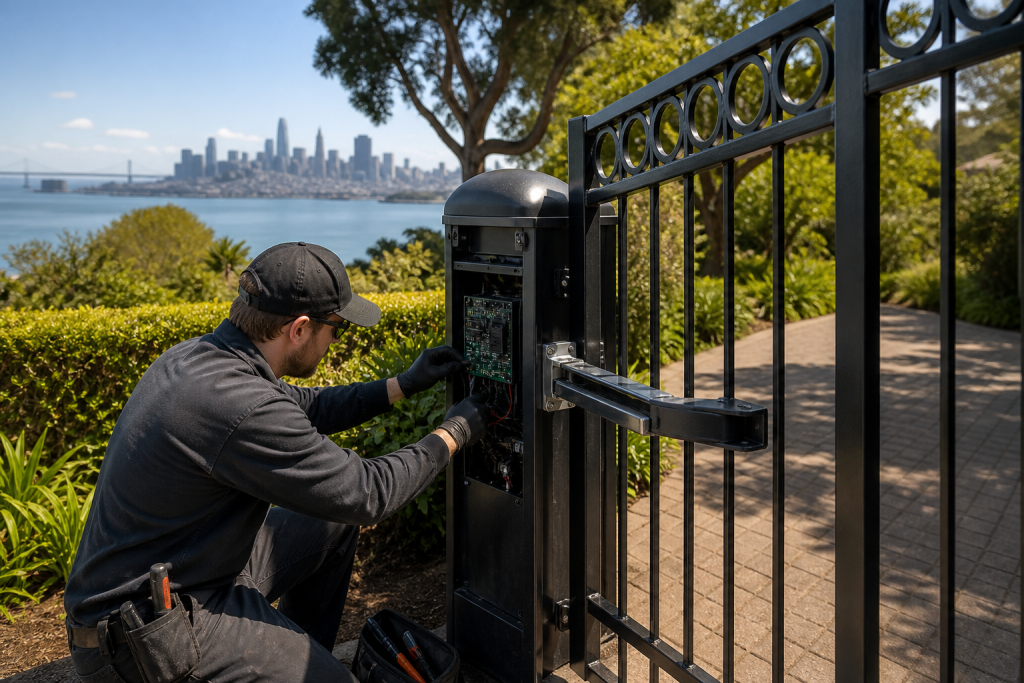
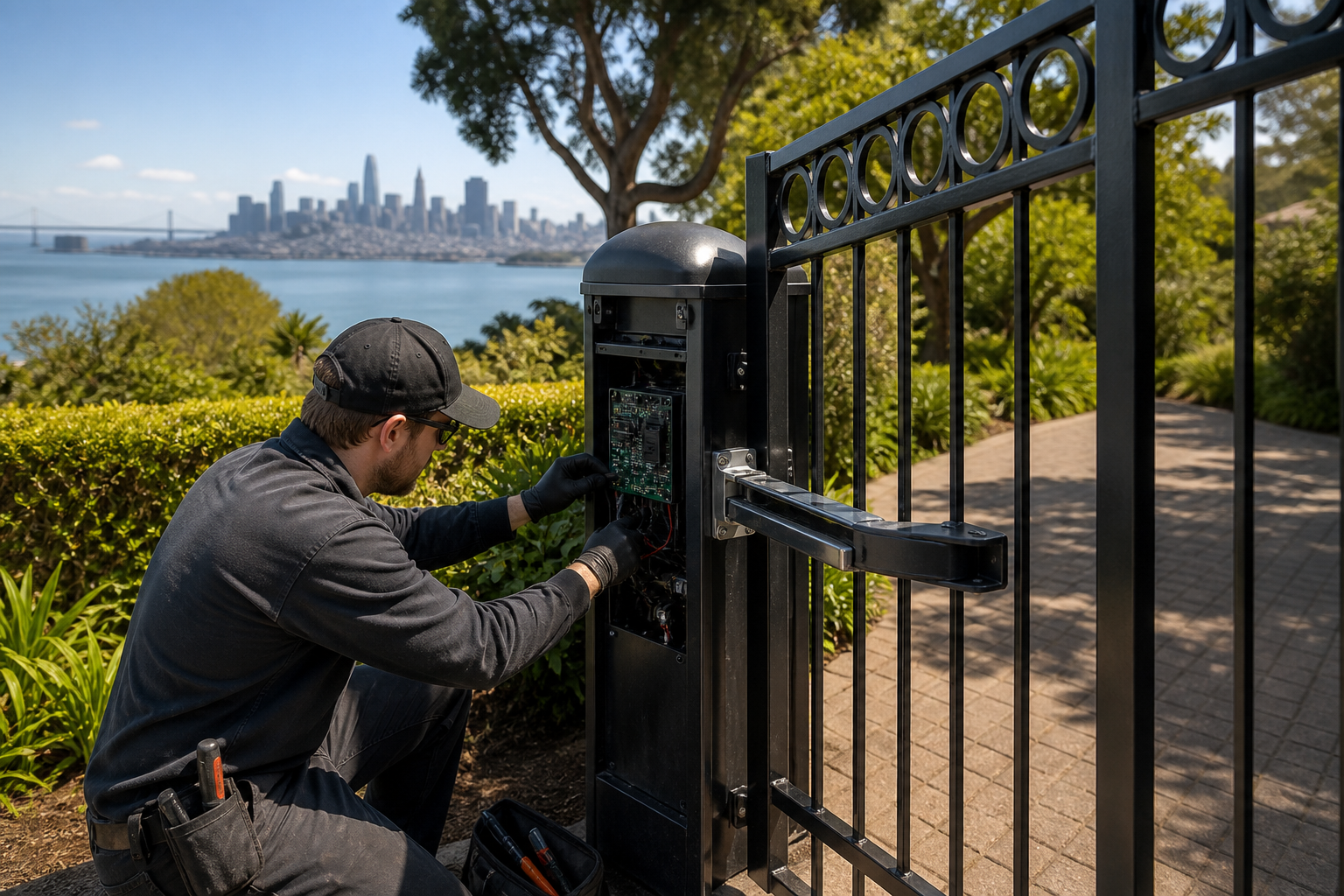
We were out in the Richmond District last month where a property manager had already gotten a $2,800 quote to replace a “failed gate motor.” Kevin pulled the operator cover—it was three years old, barely broken in. The actual problem? The DoorKing 1812 entry panel had lost its programming after a power surge, and the phone line was forwarding to a disconnected number. Two hours of reprogramming, not a motor replacement. That’s a $280 fix versus a $2,800 mistake, and it happens because most generalists don’t know DoorKing’s architecture well enough to test the right component first.
In San Francisco’s dense housing stock—Victorian conversions in the Mission, mid-century courtyard buildings in the Sunset, new construction in Dogpatch—DoorKing panels often get installed in exposed gate posts or partially covered alcoves. That setup invites the exact moisture problems we’ll cover next.
Common DoorKing Failures in San Francisco’s Climate
San Francisco’s weather looks mild on paper, but it’s uniquely hard on electronics. Our marine layer rolls in thick through the summer, salt air creeps inland from the Pacific, and temperature swings between foggy mornings and sunny afternoons create condensation cycles inside metal enclosures. Here’s what we actually replace on DoorKing systems around the city:
- Corroded entry panel circuit boards: The 1812 and 1833 series panels have exposed pin connectors that green over time. Once corrosion bridges traces, you get erratic behavior—codes work intermittently, the keypad goes dark, or the system “forgets” programmed numbers. We see this most in Sea Cliff and the Marina, where salt air is heaviest.
- Phone line to VoIP incompatibility: AT&T’s copper retirement across San Francisco has pushed thousands of properties onto Comcast, Sonic, or fiber VoIP lines. DoorKing panels built before 2015 expect analog POTS signaling. Without a proper ATA (analog telephone adapter) configured for the panel’s voltage requirements, the intercom can’t complete a call or receive the touch-tone signal to open the gate. This manifests as “the buzzer doesn’t ring my phone anymore”—not a gate problem, a telecom problem.
- Keypad membrane wear: High-traffic buildings in SoMa and the Tenderloin see thousands of button presses monthly. The rubberized membrane beneath the keys cracks, letting moisture in and breaking contact. Individual numbers stop registering, forcing residents to work around dead digits.
- Power supply degradation: DoorKing’s separate 24VAC transformers fail gradually. Voltage sags cause the panel to reboot randomly or fail to energize the strike relay. We test this with a load meter, not a guess—sagging voltage under load is invisible until it isn’t.
The pattern? Three of these four failures live in the entry panel layer, not the gate operator. A generalist who starts by disassembling your swing gate motor is working on the wrong problem.
What You Can Troubleshoot vs. What Needs a Certified Tech
We’re not going to hand you a schematic and wish you luck—DoorKing systems carry line voltage, and some configurations tie into fire alarm release circuits that have life-safety implications. But there are legitimate homeowner-level checks that help you describe the problem accurately or rule out simple causes before calling.
Safe to try yourself:
- Verify the panel has power—check the transformer LED or test the low-voltage output with a multimeter if you’re comfortable doing so
- Confirm your phone service hasn’t changed—if you switched from AT&T to Comcast last month, mention that immediately to any tech
- Test the gate operator independently: most have a manual test button or key switch that bypasses the panel entirely
- Locate your DoorKing model number (usually on a sticker inside the panel housing) and download the manual from doorking.com—programming sequences vary significantly between 1812, 1833, 1834, and 1835 models
Call a professional for:
- Any board-level repair or replacement—programming a new board requires setting location codes, time zones, and relay logic specific to your building
- Welding or structural gate repairs—our in-house welding capability exists because gate alignment issues stress operators and cause recurring “electrical” problems that are actually mechanical
- VoIP migration without proper ATA configuration—we’ve seen three panels fried this year by incorrect voltage from cheap adapters
- Fire alarm integration work—San Francisco building code requires specific release behavior, and DoorKing’s fire input isn’t a place to experiment
When to call a pro: If you’ve confirmed power and phone service are stable, but the panel still won’t respond to codes or connect calls, you’ve reached the limit of safe homeowner diagnosis. At that point, a tech with DoorKing-specific experience—and the ability to test components in isolation—saves you from replacing working equipment.
Related services in San Francisco: If your issue turns out to be the gate operator rather than the DoorKing panel, we also handle Gate Motor & Opener in Daly City and surrounding areas with the same owner-level service.
DoorKing Parts Availability and Discontinued Models
DoorKing has manufactured access control equipment since 1948, and they’ve iterated aggressively. The 1812 entry system alone has gone through four hardware revisions. For San Francisco homeowners, this creates a specific frustration: your property manager’s “maintenance guy” says the part is obsolete, but what they often mean is they don’t know the cross-reference.
Current production models (1833, 1834, 1835 series with IP connectivity) have strong distribution through Bay Area security suppliers. Legacy 1812 and 1802 boards are officially discontinued, but refurbished and compatible boards remain available through specialized gate parts channels—we stock several configurations because we encounter them regularly in older San Francisco apartment buildings.
The real pinch point isn’t the board itself. It’s the programming. A replacement 1812 board arrives blank. Restoring your building’s directory, entry codes, and relay timing requires the installation manual, patience, and often a phone call to DoorKing’s technical support line—which, in our experience, is knowledgeable but not fast. A homeowner with a full-time job and no spare Tuesday morning generally doesn’t want this project.
For properties with truly antique DoorKing systems—pre-2000 electromechanical timers, for instance—we’ll sometimes recommend a full panel upgrade rather than chasing diminishing parts availability. The cost difference between a third legacy repair and a modern IP-based system often breaks even within two service calls, and the new system’s remote management capability (change codes from your laptop instead of climbing into the gate post) is genuinely useful for San Francisco property managers juggling multiple buildings.
How to Describe Your DoorKing Problem to a Repair Tech
The most expensive service call is the one that misdiagnoses your system. Here’s how to give a gate technician the information they actually need:
- Model number first: Open the panel housing and read the sticker. “DoorKing 1812-080” tells us infinitely more than “the keypad thing.”
- Symptoms, not interpretations: Say “I punch my code and the keypad beeps twice but the gate doesn’t move” rather than “the gate motor is broken.” Those two beeps are a specific diagnostic code.
- Recent changes to phone or internet service: Any telecom switch in the last 90 days is relevant. VoIP migrations are the #1 hidden cause of “sudden” DoorKing failures.
- Whether the gate moves manually: If you can open it by hand (disengaging the operator), the mechanical side is likely fine. If it’s seized, that’s a different call entirely.
- Pattern of failure: “Works mornings but not evenings” suggests power supply or temperature-related board issues. “Stopped completely after the storm” points to surge damage. Specificity saves diagnostic time.
When you call Ironclad Gate Repair Service San Francisco, Kevin asks these questions directly because he’s the one who’ll show up with the parts. No dispatcher reading a script, no subcontractor winging it. Over 1,000 neighbors across San Francisco and the Peninsula have left reviews specifically mentioning that the person they talked to was the person who fixed their gate—that’s not accidental, it’s how we’ve structured the business for 11 years.
We also service Gate Repair in Daly City and Gate Installation in Daly City for properties just south of the city limits with the same DoorKing expertise.
Key Takeaways
- DoorKing systems separate into entry panel, gate operator, and communication layers—knowing which has failed prevents expensive misdiagnosis
- San Francisco’s marine climate causes specific, predictable failures: corroded boards, keypad wear, and moisture-related power issues
- Phone service changes (especially VoIP migrations) are the most common hidden cause of “sudden” DoorKing problems
- Legacy DoorKing parts exist but often require cross-referencing expertise; discontinued models may justify upgrade over repeated repairs
- Accurate symptom description—model number, recent changes, exact behavior—gets you a correct quote and a faster fix
The Bottom Line
DoorKing systems are built to last decades, but they’re not built to be serviced by generalists. The modular design that makes them reliable also makes them easy to misdiagnose if you’re treating the gate, the panel, and the phone connection as one mysterious black box. In San Francisco’s specific climate and infrastructure environment—salt air, copper-to-VoIP transitions, dense multifamily housing—that specialized knowledge matters more than it does in drier, newer-built markets.
If you’re in San Francisco and your DoorKing system is acting up, Ironclad Gate Repair Service San Francisco offers free estimates with owner-level diagnostics. Kevin handles it personally, we stock parts and weld on-site, and we work on your brand—whether it’s DoorKing, BFT, Linear, Ghost Controls, or any of the nine major systems we certify on. Call (866) 788-1265 and describe what you’re seeing. We’ll tell you honestly whether it’s a panel programming fix, a phone line issue, or something that needs hands-on repair.
Frequently Asked Questions
DoorKing repairs in San Francisco typically range from $180 for programming or keypad replacement to $450–$650 for entry panel board replacement with reprogramming. If the gate operator itself has failed, motor repairs or replacement run higher. Call (866) 788-1265 for an exact quote—estimates are free.
Your DoorKing panel was designed for traditional analog phone lines (POTS), and most VoIP services don’t provide the correct voltage or signaling for the panel’s internal modem. The fix is usually a properly configured analog telephone adapter (ATA), not a new gate system. This is one of the most common calls we get in San Francisco properties that have recently changed telecom providers.
If you have the exact model manual and the master programming code, some basic functions—adding or deleting user codes, changing the time—are accessible to homeowners. However, initial board setup, directory programming for intercom systems, and relay configuration require specific sequences that are poorly documented and easy to lock up. We generally recommend professional programming for anything beyond simple code changes, especially in San Francisco’s competitive rental market where tenant turnover is high.
If your panel is pre-2010 and has already needed two major repairs, replacement often makes financial sense. Modern DoorKing systems offer IP connectivity, remote management, and better smartphone integration—valuable features for San Francisco property managers. We’ll assess your specific model and failure history and give you an honest comparison. Call (866) 788-1265 to discuss whether repair or upgrade fits your situation.
Written by Kevin Flores, Owner & Lead Technician at Ironclad Gate Repair Service San Francisco, serving San Francisco since 2015.
Need Gate Repair Help?
Call Ironclad Gate Repair Service San Francisco — licensed & insured, here with fast after-hours help in San Francisco.
(866) 788-1265